Within Acoustics
When a Quiet UFO Is Not Silent
A silent-looking light is not automatically strange because distance, delay and background noise can hide ordinary sound.
On this page
- What silence does and does not prove
- Sound delay, distance and missed noise
- How detectors label silence with uncertainty
Page outline Jump by section
Introduction
A light that appears completely silent is not, by itself, evidence of an unusual or unexplained object. Human hearing is limited by distance, weather, background noise and the speed at which sound travels. For automated instrumented UFO detectors, this matters because a camera can record a striking visual event while microphones detect nothing for entirely ordinary reasons. Rather than treating silence as proof of mystery, well-designed monitoring systems treat it as one piece of evidence with an associated level of uncertainty. This approach matches the broader recommendation from NASA’s independent UAP study: reliable conclusions depend on multiple calibrated sensors and careful measurement rather than witness impressions alone.[NASA Science]science.nasa.govScience Independent Study Team ReportNASA ScienceIndependent Study Team ReportSeptember 13, 2023 — The study of Unidentified Anomalous Phenomena (UAP) presents a unique scien…
What silence does and does not prove
The most common mistake in eyewitness accounts is assuming that “I heard nothing” means “the object made no sound”. Those are different claims.
A silent observation may simply indicate that any sound reaching the observer fell below the hearing threshold. Aircraft engines, drone propellers and meteor shock waves all weaken with distance, while wind, traffic, insects, surf and urban background noise further reduce the chance that a listener notices them. Even a trained observer can overlook weak or delayed sounds when concentrating on a bright moving light.
The reverse is also true. If an object genuinely appears low, nearby and moving slowly, yet calibrated microphones and several observers detect no corresponding sound, some explanations become less likely. A low helicopter or nearby quadcopter would normally be expected to produce detectable acoustic energy under favourable conditions. However, this still does not identify the object. It simply changes the balance of probabilities and encourages investigators to test alternatives such as a more distant aircraft, satellite, balloon, astronomical object or an error in judging distance.[arXiv]arxiv.orgarXiv Multi-Band Acoustic Monitoring of Aerial SignaturesMulti-Band Acoustic Monitoring of Aerial SignaturesMay 29, 2023…
For automated detector networks, the key principle is that silence rarely identifies a phenomenon. Instead, it helps eliminate explanations that should have produced measurable sound under the observed conditions.
Sound delay, distance and missed noise
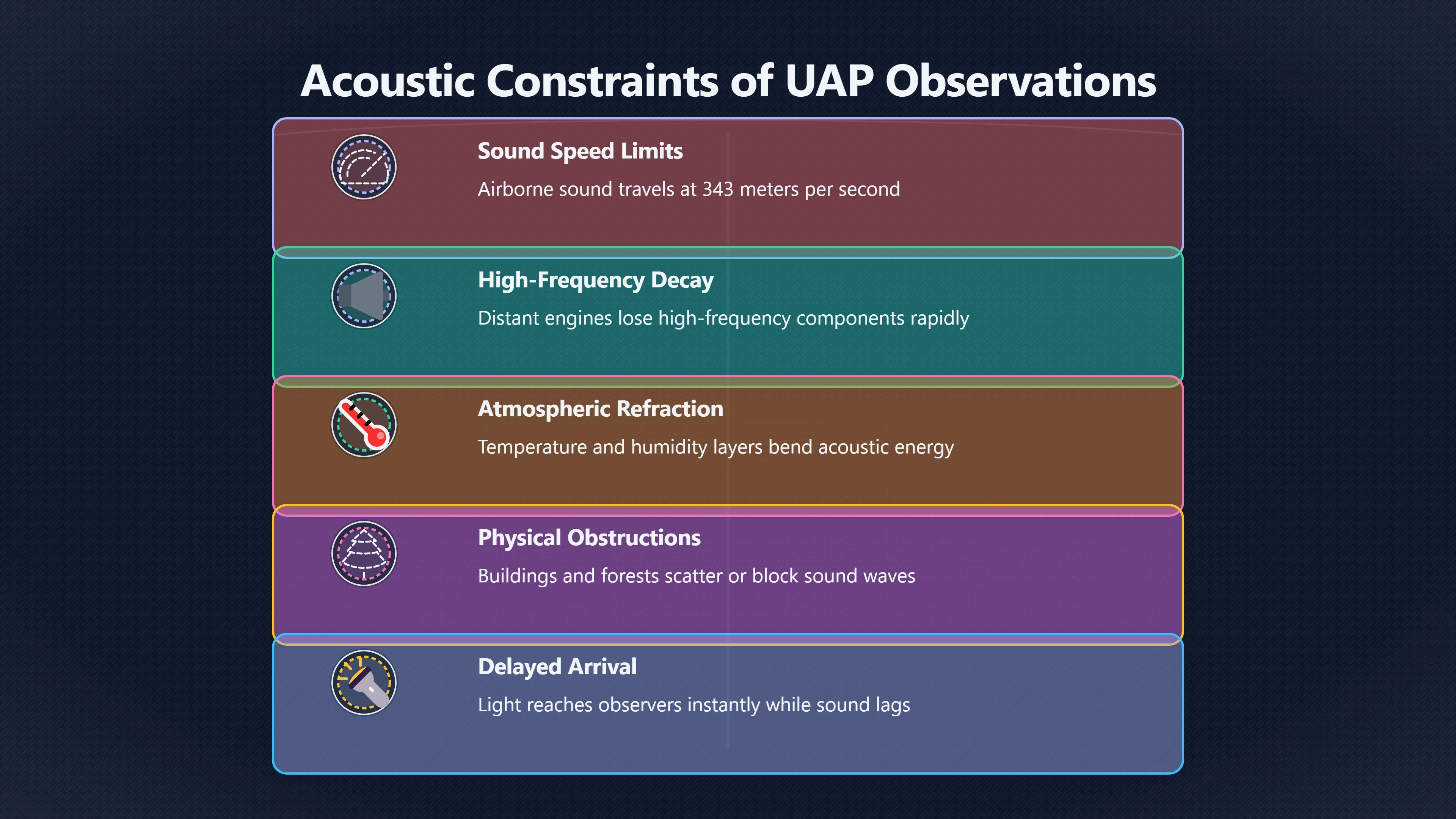
One reason witnesses underestimate ordinary explanations is that light reaches an observer almost instantly, while sound travels through air at only about 343 metres per second under typical conditions.
That difference creates several effects:
- An aircraft several kilometres away may appear visually present long before its engine noise becomes noticeable.
- A meteor may produce a brilliant flash followed by delayed rumbling or infrasound, leading witnesses to believe the sound came from something else.
- If observers stop paying attention immediately after a light disappears, they may never notice the delayed arrival of the associated sound.
Distance also changes how sound behaves. High-frequency components fade more rapidly than low-frequency ones, making distant engines sound quieter and less distinctive. Atmospheric temperature layers, wind direction and humidity can refract or absorb sound, sometimes carrying it away from an observer rather than toward them. Hills, buildings and forests further block or scatter acoustic energy.
This explains why two observers can report different experiences of the same event. One may hear an aircraft clearly while another, only a short distance away but downwind or beside heavy traffic, reports complete silence.
For automated stations, microphones continuously record these conditions rather than relying on memory. A station can later compare the timing of any detected sound with the optical recording, helping distinguish genuine absence from simple non-detection.[arXiv]arxiv.orgarXiv Multi-Band Acoustic Monitoring of Aerial SignaturesMulti-Band Acoustic Monitoring of Aerial SignaturesMay 29, 2023…

Human perception adds another source of error
People are generally poor at estimating the distance and size of isolated lights in a dark sky because there are few visual reference points. If a distant airliner is mistaken for a nearby object, observers naturally expect loud engine noise. When none is heard, the event can seem anomalous even though the original distance estimate was incorrect.
Researchers studying physical constraints on reported UAP have also noted that incorrect range estimates can dramatically change conclusions about speed, acceleration and expected physical signatures. A single optical viewpoint without reliable distance information can therefore create misleading expectations about whether sound should have been present at all.[Center for Astrophysics]lweb.cfa.harvard.eduCenter for Astrophysics DRAFT,UNDER REVIEWWe derive physical constraints on interpretations of “highly maneuverable” Unidentified Aerial Phe- nomena (UAP) based on standard…Rea…
How detectors label silence with uncertainty
Automated instrumented UFO detectors are designed to avoid binary conclusions such as “silent” or “not silent”. Instead, they ask whether the monitoring equipment should reasonably have detected a sound if a particular explanation were correct.
A practical assessment typically considers:
- Estimated range: Was the object likely within the effective acoustic detection distance?
- Ambient noise: Was wind, rain or nearby traffic masking weaker sounds?
- Microphone sensitivity: Could the recording system detect sounds at the expected level?
- Expected source type: Would a drone, aircraft or meteor normally produce audible, infrasonic or ultrasonic signatures?
- Timing: Was enough time allowed for delayed sound arrival?
The Galileo Project’s proposed AMOS (Acoustic Monitoring Omni-directional System) illustrates this philosophy by combining audible, infrasonic and ultrasonic microphones. The aim is not to prove extraordinary explanations but to increase confidence when identifying ordinary aerial phenomena and to document when expected acoustic signatures are genuinely absent. Under favourable conditions, audible aircraft-sized sources may only be detectable out to roughly a kilometre, while infrasonic signals from energetic events can travel much farther. Knowing these limits prevents investigators from interpreting every quiet observation as unusual.[arXiv]arxiv.orgarXiv Multi-Band Acoustic Monitoring of Aerial SignaturesMulti-Band Acoustic Monitoring of Aerial SignaturesMay 29, 2023…
Why “no sound” is weaker evidence than many people expect
Silence is often psychologically compelling because people intuitively associate nearby moving objects with obvious noise. Physics is less straightforward.
A quiet-looking light may still be entirely consistent with:
- a distant commercial aircraft viewed without reliable depth cues;
- a satellite reflecting sunlight after sunset;
- a high-altitude balloon;
- a meteor whose acoustic effects arrive much later or mainly as low-frequency waves;
- environmental conditions that prevented sound reaching the observer;
- local background noise masking weak acoustic signals.
Conversely, a truly unexplained event is strengthened not by a witness simply reporting silence, but by multiple calibrated sensors demonstrating that an expected sound should have been detectable yet was consistently absent across independent instruments.
This distinction is why modern automated observation projects emphasise multimodal sensing. Cameras document what was seen, microphones record what could actually be heard, and both datasets are analysed together rather than allowing the subjective impression of silence to become evidence on its own. That approach reduces false mysteries while providing a more rigorous basis for investigating the small number of events that remain unexplained after ordinary causes have been tested.[NASA Science+2arXiv]science.nasa.govScience Independent Study Team ReportNASA ScienceIndependent Study Team ReportSeptember 13, 2023 — The study of Unidentified Anomalous Phenomena (UAP) presents a unique scien…
Amazon book picks
Further Reading
Books and field guides related to When a Quiet UFO Is Not Silent. Use these as the next step if you want deeper reading beyond the article.

UFOs : Generals, Pilots, and Government Officials Go on the R...
Illustrates why stronger evidence standards matter.
The Demon-Haunted World
Encourages evidence-based interpretation of unusual observations.
eBay marketplace picks
Marketplace Samples
Live-tested eBay searches with available results related to this page.




Endnotes
1.
Source: science.nasa.gov
Title: Science Independent Study Team Report
Link:https://science.nasa.gov/wp-content/uploads/2023/09/uap-independent-study-team-final-report.pdf
Source snippet
NASA ScienceIndependent Study Team ReportSeptember 13, 2023 — The study of Unidentified Anomalous Phenomena (UAP) presents a unique scien...
Published: September 13, 2023
2.
Source: arxiv.org
Link:https://arxiv.org/abs/2305.18566
3.
Source: arxiv.org
Title: arXiv Multi-Band Acoustic Monitoring of Aerial Signatures
Link:https://arxiv.org/abs/2305.18551
Source snippet
Multi-Band Acoustic Monitoring of Aerial SignaturesMay 29, 2023...
Published: May 29, 2023
4.
Source: lweb.cfa.harvard.edu
Title: Center for Astrophysics DRAFT,UNDER [REVIEW]({{ ‘review/’ | relative_url }})
Link:https://lweb.cfa.harvard.edu/~loeb/LK1.pdf
Source snippet
We derive physical constraints on interpretations of “highly maneuverable” Unidentified Aerial Phe- nomena (UAP) based on standard...Rea...
Additional References
5.
Source: [acoustics]({{ ‘acoustics/’ | relative_url }}). org
Link:https://acoustics.org/pressroom/httpdocs/165th/4aPPb5_Edewaard.html
6.
Source: thedebrief.org
Link:https://thedebrief.org/did-microphones-recently-capture-the-mystery-sound-of-unidentified-anomalous-phenomena/
Source snippet
Did Microphones Recently Capture the 'Mystery Sound' of...10 Nov 2023 — The advanced set of microphones of the Galileo Project observato...
7.
Source: avi-loeb.medium.com
Title: a new calculation on the fly to the nasa uap study 2dacaf860cac
Link:https://avi-loeb.medium.com/a-new-calculation-on-the-fly-to-the-nasa-uap-study-2dacaf860cac
Source snippet
New Calculation on the Fly to the NASA UAP Study - Avi LoebThe NASA Study will examine unclassified data on UAP in an attempt to separate...
8.
Source: leonarddavid.com
Title: nasa report released unidentified anomalous phenomena uap
Link:https://www.leonarddavid.com/nasa-report-released-unidentified-anomalous-phenomena-uap/
Source snippet
Unidentified Anomalous Phenomena (UAP) – UPDATED14 Sept 2023 — NASA has released its Unidentified Anomalous Phenomena (UAP) report comple...
9.
Source: youtube.com
Title: NASA Unidentified Anomalous Phenomena Independent Study Report
Link:https://www.youtube.com/watch?v=TQcqOW39ksk
Source snippet
Inside the AI Alien Hunting Project at Harvard - YouTube Inside the AI Alien Hunting Project at Harvard - YouTube...
10.
Source: worldscientific.com
Link:https://www.worldscientific.com/doi/10.1142/S2251171723400068?srsltid=AfmBOoqfODLpIUC0aMnSQY_6KWBrsInCuz2pepwl9bKSjC7Gznf2BLpu
Source snippet
The Scientific Investigation of Unidentified Aerial...by WA Watters · 2023 · Cited by 47 — A primary objective of the Galileo Project is...
11.
Source: youtube.com
Title: The Galileo Project’s First Data on Half a Million Objects
Link:https://www.youtube.com/watch?v=uJtER5ahdPY
Source snippet
NASA Unidentified Anomalous Phenomena Independent Study Report...
12.
Source: youtube.com
Title: How the Galileo Project Is Changing the Game
Link:https://www.youtube.com/watch?v=56So2gXKFcg
Source snippet
The Galileo Project's First Data on Half a Million Objects...
13.
Source: youtube.com
Title: Inside the AI Alien Hunting Project at Harvard
Link:https://www.youtube.com/watch?v=oDAY0_wRjxA
Source snippet
Using AI to Detect Strange Events in the Sky...
14.
Source: youtube.com
Title: Using AI to Detect Strange Events in the Sky
Link:https://www.youtube.com/watch?v=nHMEfP68jqI
Source snippet
How the Galileo Project Is Changing the Game...
Topic Tree